
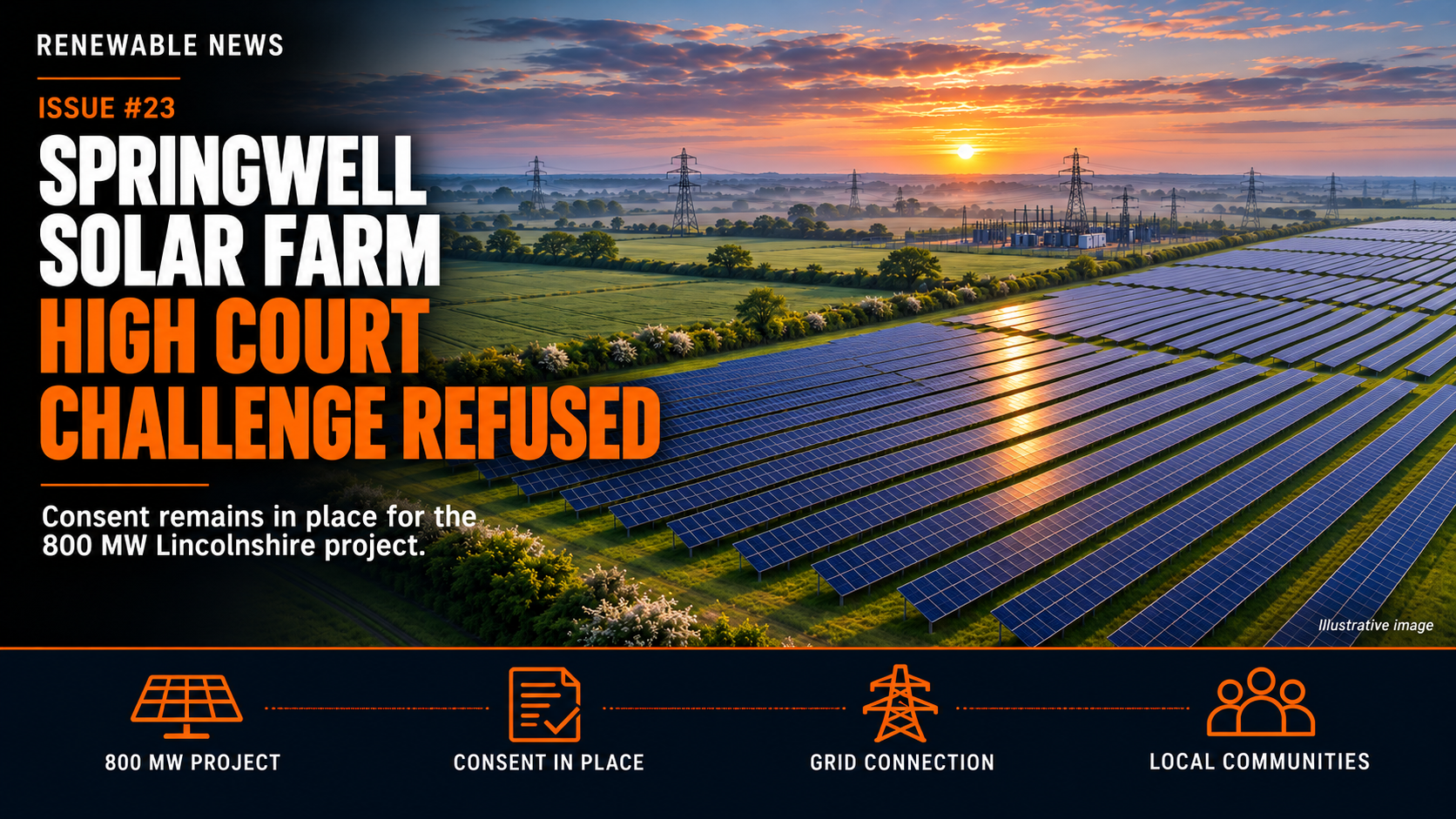

RENEWABLE NEWS – ISSUE #23
SPRINGWELL SOLAR FARM CHALLENGE REFUSED BY HIGH COURT
The 800MW Lincolnshire project retains its consent following a court setback for two councils. What does the outcome mean for renewable energy, local communities and project delivery?
Lincolnshire County Council and North Kesteven District Council have been refused permission to take their challenge to the approval of Springwell Solar Farm to a full judicial review hearing, according to Local Democracy Reporting Service coverage published on 11 November 2026.[1]
The outcome leaves the project’s development consent in place. It also keeps attention on a wider question: how should the UK balance the need for new electricity generation with the effects of large developments on rural communities?
WHAT HAS HAPPENED
The government granted development consent for Springwell on 8 April 2026. The scheme is located in North Kesteven, between Lincoln and Sleaford, and includes solar generation, battery storage and supporting grid infrastructure.[2]
The councils challenged the approval, arguing that the assessment had not adequately addressed impacts on villages and landscapes or the cumulative effects of developments across Lincolnshire. The High Court refused to allow the claim to proceed to a full hearing on 11 November.[1]
WHY THE PROJECT MATTERS
At the time of approval, the government described the 800MW scheme as the UK’s largest solar project by power generation. It cited the developer’s estimate that annual output could match the electricity needs of more than 180,000 homes.[3]
That household figure is an annual energy comparison. It should not be read as a promise that those homes would receive continuous electricity directly from the site.
The government presented the approval as part of its drive for more domestic clean power and reduced exposure to volatile international fossil fuel markets.[3]
WHY THE COUNCILS OBJECTED
The dispute brings together concerns about agricultural land, landscape change and the combined effect of several major energy developments.
Lincolnshire County Council’s published record identified objections involving landscape and visual impacts, the loss of high-quality agricultural land, heritage, solar waste and uncertainty over the proposed grid connection.[4]
Following the court outcome, council leaders defended bringing the challenge and expressed disappointment that it would not receive a full hearing.[1]
The practical issue for developers is that securing consent does not necessarily resolve local disagreement. How commitments are communicated and delivered remains important throughout construction and operation.
WHAT THE COURT OUTCOME TELLS US
Judicial review examines whether a public decision was made lawfully. It does not normally ask a judge to choose the development they personally consider best. Permission is needed before a claim can proceed.[5]
The reported refusal should therefore not be presented as the court endorsing every aspect of Springwell’s design, or as proof that residents’ concerns have disappeared.
Equally, the outcome concerns this particular challenge. It does not establish that other solar proposals will automatically obtain consent or be protected from legal scrutiny.
GRID CONNECTION REMAINS CENTRAL
Springwell is being developed jointly by EDF power solutions UK and Luminous Energy. In its April announcement, EDF said the project had an agreement with National Grid allowing exports of up to 800MW and was targeting electricity exports from 2029.[6]
The county council’s published record identifies a dependency on a proposed new National Grid substation at Navenby.[4]
A connection agreement and a completed, energised connection are different delivery milestones. The April target is a published programme ambition; the court outcome alone does not confirm that it will be achieved.
WHAT PROJECT TEAMS SHOULD TAKE FROM THIS
For developers, designers and delivery teams, the case is a reason to keep planning evidence, technical assumptions and delivery programmes connected.
Grid infrastructure dependencies should be visible in the programme. Changes to layouts, cable routes or equipment should be checked against the consented scheme and its requirements. Community commitments should have clear owners and a record of delivery.
RECENERGY INSIGHT
Large solar projects need both a credible case for approval and a workable route to operation.
The Springwell decision highlights how national energy priorities, local land-use concerns and grid infrastructure can converge on one scheme. A successful planning outcome is a major milestone, while the detailed work of delivery continues.
From a design perspective, quality means making assumptions clear, coordinating the electrical design with the connection strategy, and checking that drawings and calculations remain consistent as the project develops.
For communities, clear information about construction, landscape measures and project commitments remains valuable after a decision has been made.
The focus now is how the approved scheme progresses and how its commitments translate into work on the ground.
REFERENCES
[1] Local Democracy Reporting Service / LincolnshireWorld – Councillors react to High Court defeat in battle to stop UK’s biggest solar farm. Published 11 November 2026; updated 12 November 2026. Reporting on the permission-stage outcome. Read source
[2] Planning Inspectorate – Springwell Solar Farm development consent decision announced, 8 April 2026. Official confirmation of consent. Read source
[3] Department for Energy Security and Net Zero – Government approves UK’s largest power-producing solar farm, 8 April 2026. Capacity and the developer’s household-equivalent estimate. Read source
[4] Lincolnshire County Council – Decision record on issuing a Pre-Action Protocol Letter concerning Springwell, April 2026. Council objections and the Navenby substation dependency. Read source
[5] Courts and Tribunals Judiciary – Overview of the Administrative Court. Explanation of judicial review and the permission stage. Read source
[6] EDF – Major milestone as Government grants Development Consent Order for Springwell Solar Farm, 8 April 2026. Developer statement on partners, connection agreement and delivery target. Read source
Ray Metcalfe – Founder & CEO
RECenergy – Renewable Energy & Infrastructure
GRID | DESIGN | GLOBAL STAFFING | SUPPORT
0333 305 0717