
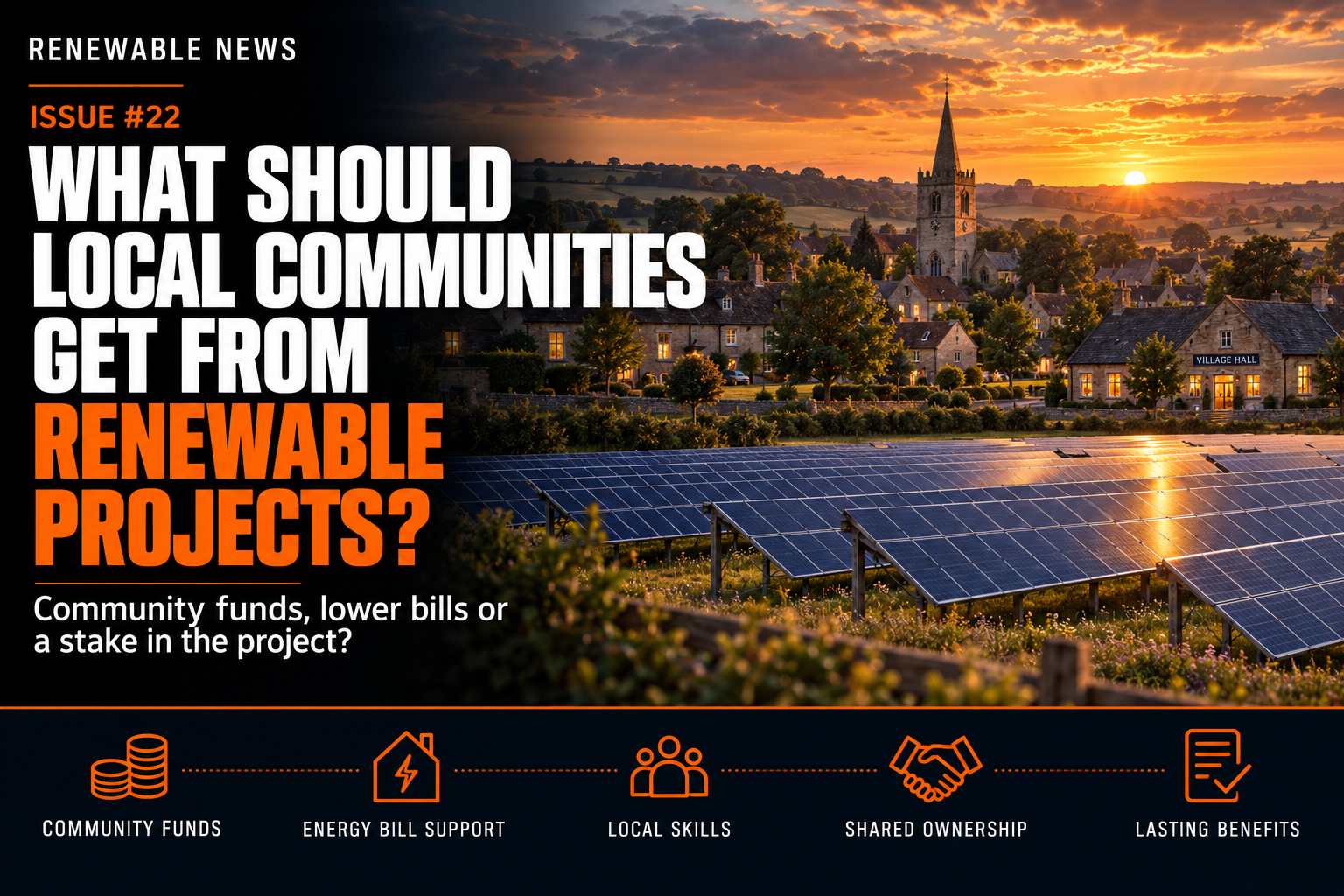

RENEWABLE NEWS – ISSUE #22
Community funds, lower bills and shared ownership are all part of the debate. But what makes a fair arrangement for residents, developers and the wider public?
A solar farm can supply electricity to the wider energy system while changing the surroundings of the communities closest to it.
Supporters may see investment, cleaner generation and opportunities for local funding. Other residents may be concerned about land use, landscape changes, construction traffic or the cumulative effect of several developments.
Community benefits aim to share some of a project’s value locally. However, they raise questions of their own.
How much should developers contribute? Who should receive the benefits? And can a financial package address concerns that are not primarily about money?
WHY THE ISSUE IS BEING DISCUSSED
Community benefit arrangements already operate across parts of Britain’s renewable energy sector, but their value and structure vary.
In May 2025, the UK government published a working paper exploring a potential mandatory community benefits scheme for low-carbon energy infrastructure, alongside measures to encourage shared ownership.
The paper considered how a more consistent approach might work. It did not itself establish a universal right to payments.[1]
The argument for consistency is that similar communities could otherwise receive different offers depending on the developer, location and negotiation process.
However, standardisation also creates challenges. Technologies and projects have different costs, revenues and operating conditions. A contribution that is manageable for one development may be more difficult for another.
Energy Saving Trust supports mandatory community benefits, while also calling for further analysis of affordability and suitable contribution levels across technologies. This is its policy position, rather than evidence that every proposed contribution would be affordable.[2]
COMMUNITY FUNDS: FLEXIBILITY WITH RESPONSIBILITIES
A community fund can support local facilities, energy-efficiency improvements, transport initiatives or youth activities.
Regular funding may allow communities to plan projects that would otherwise struggle to secure support.
However, receiving money creates responsibilities. Someone must decide who qualifies, assess applications, manage conflicts of interest and publish accounts.
A fund may also divide opinion. Some residents may favour investment in shared facilities; others may prefer direct household support.
Energy Saving Trust highlights the need for impartial advice and the risk that communities with greater time, expertise and organisational capacity could benefit more than those without those resources.[2]
The practical question is how much funding reaches useful projects after the costs of managing it.
LOWER BILLS: AN ATTRACTIVE IDEA WITH PRACTICAL LIMITS
Household bill support can make the connection between an energy development and its neighbours more visible.
But living near a solar farm does not automatically provide access to discounted electricity. A scheme needs an agreed financial and delivery arrangement.
Reduced tariffs are among the community benefit models examined in government analysis.[3]
Questions include whether tenants qualify, whether households must use a particular supplier, and how eligibility changes when people move.
There is also a choice between immediate and longer-term support. Bill discounts can provide direct relief, while insulation or improvements to community buildings may reduce costs over a longer period.
Neither approach will necessarily suit every household.
SHARED OWNERSHIP: POTENTIAL RETURNS AND FINANCIAL RISK
Shared ownership gives a community organisation a financial interest in a development.
Research by Regen, published through the William Grant Foundation, argues that this can provide social and economic benefits beyond traditional community funds and strengthen relationships between developers and communities.[4]
However, an ownership stake is an investment. Returns depend on the structure and performance of the project, alongside financing and operating costs.
Communities need access to capital, professional advice and people able to oversee the arrangement. Energy Saving Trust identifies access to affordable finance as a significant barrier.[2]
It is also important to distinguish income for individual investors from benefits available to the wider community. A locally marketed investment does not automatically distribute its returns to every nearby household.
DO FINANCIAL OFFERS CHANGE LOCAL OPINION?
A clear benefit package may help demonstrate what a development could contribute locally.
But opposition may concern the location or scale of a project rather than the absence of financial benefits.
Reporting by The Times on a proposed solar development near Egremont described local resistance despite an offer of a community benefit and education fund worth approximately £680,000.[5]
One example cannot establish how communities generally respond. It does illustrate why an offer of money should not be treated as evidence that residents will—or should—support a project.
A benefit package and the merits of a development remain separate questions.
HOW MUCH SHOULD SOLAR DEVELOPERS CONTRIBUTE?
There is no single figure that resolves the debate.
In February 2026, the Scottish Government proposed a recommended solar contribution of £700–£1,000 per megawatt per year as part of a refresh of its community benefit guidance.[6]
Applied to a 50MW project, that proposed range would equate to £35,000–£50,000 annually.
These figures were published as Scottish proposals, rather than a mandatory UK-wide solar rate.
A fixed payment based on capacity offers predictability. A payment linked to generation may respond more closely to project output, but could make community income less certain.
Comparisons also need to account for payment duration, inflation, administration costs and any additional benefits included.
BENEFITS AND PLANNING
Community contributions should not be confused with measures required to make a development acceptable in planning terms.
West Lindsey District Council’s policy for large-scale solar, battery storage and substations explicitly separates community benefit negotiations from planning decisions.[7]
This distinction allows residents to discuss potential benefits while retaining their views on whether a project is suitable.
It also avoids treating a community contribution as a substitute for addressing the development’s impacts.
WHAT WOULD MAKE AN AGREEMENT EASIER TO ASSESS?
Whatever model is chosen, the terms need to be clear:
- Who qualifies, and why?
- What is the annual value and duration?
- Who controls spending and publishes decisions?
- What happens if ownership of the development changes?
- How are complaints and missed commitments handled?
- Which benefits are guaranteed, and which depend on project performance?
These details make it easier to compare an attractive headline with what will actually be delivered.
RECENERGY INSIGHT
Community benefits can provide useful local funding, but their value depends on the arrangement and the priorities of the people involved.
Developers need commitments they can finance and deliver. Residents need clear information, meaningful participation and the freedom to disagree with a proposal.
A fair assessment considers both the opportunities and the limitations. It asks what a package delivers, who receives it and what responsibilities or risks accompany it.
There is unlikely to be one model that suits every solar project or every community.
REFERENCES
- Department for Energy Security and Net Zero – Community benefits and shared ownership for low-carbon energy infrastructure: working paper, 21 May 2025. Government policy proposals.
- Energy Saving Trust – Community benefits and shared ownership: our response. Policy response supporting community benefits and shared ownership; originally published July 2025, with the page dated February 2026.
- Department for Energy Security and Net Zero – Community benefits and shared ownership: analytical annex, May 2025. Government analysis of potential arrangements.
- Regen / William Grant Foundation – Sharing power: Unlocking shared ownership for a fast and fair net zero transition. Research examining the case for shared ownership.
- The Times – The town that said no to a £700,000 offer from a solar farm firm. Independent reporting; subscription may be required.
- Scottish Government – Communities benefit from renewable energy, 18 February 2026. Announcement of proposed changes to community benefit guidance.
- West Lindsey District Council – Frequently asked questions regarding the Large-Scale Renewable Energy Community Benefit Policy. Explanation of the council’s local policy.
Ray Metcalfe – Founder & CEO
RECenergy – Renewable Energy & Infrastructure
GRID | DESIGN | GLOBAL STAFFING | SUPPORT
0333 305 0717